
Understanding Airbnb Fee Structure
I have received multiple questions from owners who have confusion since the Airbnb fee structure changed back in October 2025. So I’m here today to try and break it down easily for people to understand. The fees didn't disappear, they just moved. Here's exactly what happened and what it means for your pricing. While it’s a review for most, it’s also been six months since the changes and if you haven’t been tracking your percentage of revenue paid to fees now is the time to start doing so and making adjustments if needed.
If you're an Airbnb host and you've been confused by the fee structure change that rolled out on October 27, 2025, you're not alone. We've had conversations with individual hosts on the Emerald Coast who either didn't know it happened, didn't fully understand what changed, or most dangerously, either didn't adjust their pricing to account for it or just assumed raise it by the single fee amount and call it good.
The short version: Airbnb shifted the platform fees from the guest's side of the transaction to the host's side. The total money flowing through the platform didn't change much. But if you didn't raise your rates, you quietly started earning less on every single booking. During the past few months of transitioning, was probably the biggest risk in everyone having to adjust their pricing models, going forward it will become built into normal practices.
Like I said, I’ve ran into a few owners recently who had questions on it, let's try and break it down clearly, with real numbers.
How Airbnb Fees Used to Work (The Split-Fee Model)
Before October 27, 2025, Airbnb used what's called a split-fee structure. Both the host and the guest each paid a separate service fee to Airbnb.
Host fee: Approximately 3% deducted from your payout.
Guest service fee: Roughly 14–16% added on top of your listed nightly rate at checkout.
Here's what that looked like in practice.
The guest saw the $200 listing price when searching — but by the time they got to checkout, it ballooned to around $228. That checkout sticker shock was a real problem for Airbnb's conversion rates. Guests would search, get excited, then abandon the booking when fees appeared.
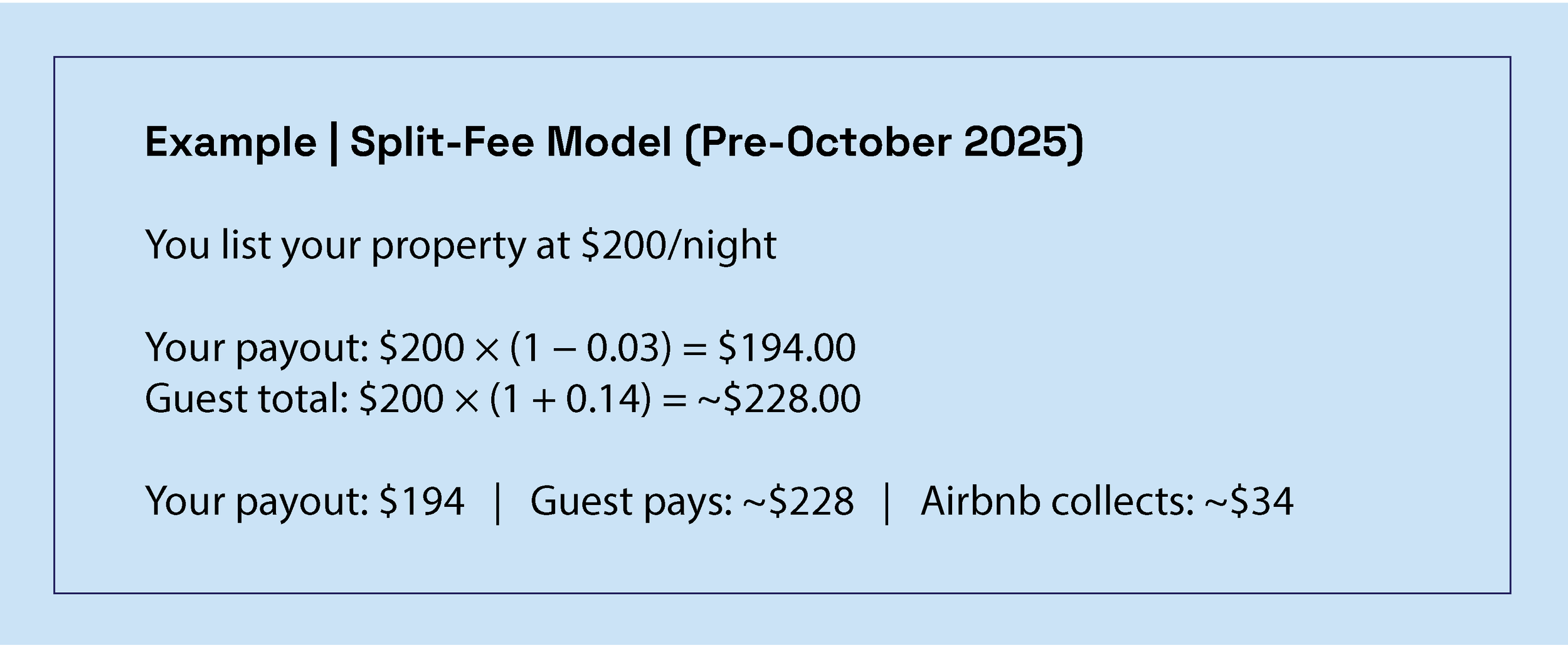
The guest saw the $200 listing price when searching — but by the time they got to checkout, it ballooned to around $228. That checkout sticker shock was a real problem for Airbnb's conversion rates. Guests would search, get excited, then abandon the booking when fees appeared.
What Changed: The Single-Fee (Host-Only) Model
Effective October 27, 2025, Airbnb transitioned all hosts connected through property management software (PMS) to a new single-fee model. Hosts not using PMS software followed by December 1, 2025.
Under the new structure:
Guests pay NO separate Airbnb service fee at checkout like they used to. A guest fee ranging usually from 14-16% was added on to the guests total.
What they see listed is what they pay now (plus applicable taxes).
Hosts now pay a flat 15.5% service fee, deducted directly from their payout.
On the surface, this sounds guest-friendly, and it is. But here's where many hosts got caught off guard: if you didn't raise your listed rates to compensate, you started absorbing the full 15.5% fee out of what used to be your revenue. The 15.5% is based off your total nightly rates plus any fees you have added on (eg. cleaning fee) that I’ve seen multiple owners not account for.
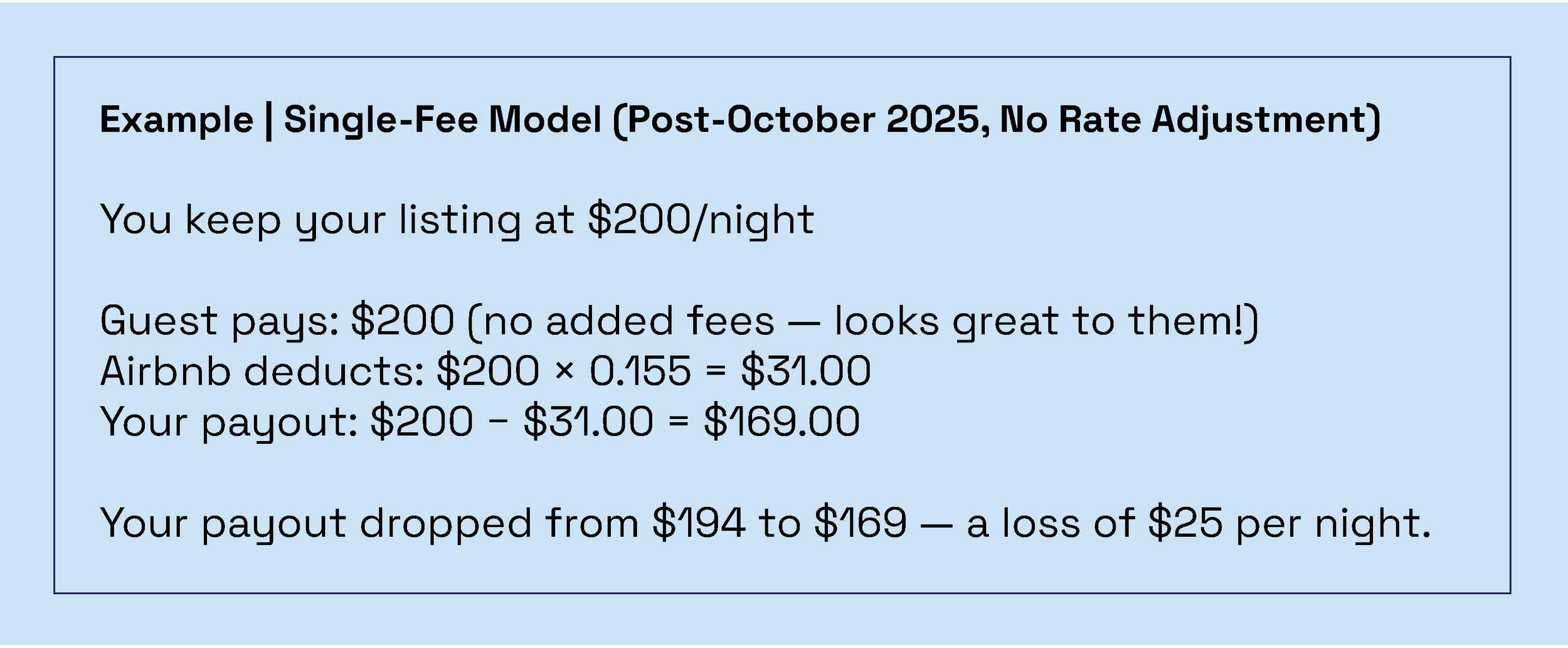
Your payout dropped from $194 to $169 — a loss of $25 per night.
That's a 12.9% reduction in your take-home pay per booking. Over a full season, that adds up to a substantial income loss — without a single thing visibly changing from the guest's perspective.
A 18.34% Rate Increase Covers All Fees
After this first year of the changes, the pricing models will start to become baked into everyone’s business models, the challenge for everyone the past few months was increasing their rates to absorb the fee shift so continue their baseline profitability.
One way to think about the change if you are using a base rate and want to ensure you raise enough to cover the shift in the fees, if you increase it 18.34%, then that will cover all the fees. This is just one way to think about it, but if you have same base rate in both models, if you increase your price by 18.34% then you will know that your increase covered the fees on the base amount plus the fees on the marked up amount. You might think: "The fee is 15.5%, so I just need to raise my prices by 15.5%.", while that should workout to nearly even, its also not quite what people expect and here's why.
When you raise your rate by X%, Airbnb's 15.5% fee is applied to your new, higher nightly rate. So simply adding 15.5% to your old rate doesn't fully recover what you're giving up. Most people calculate just the 15.5% markup, and don’t calculate the 15.5% on that mark up amount.
So for example, if the nightly rate is $100, the host adds 15.5% to the $100 they charge the $115.50 for the night. Many people will think they’ll actually be paying $15.50 in fees and have $100 in payout. But the 15.5% comes off the total, and 15.5% of $115.50 is actually $17.90 so their payout is actually $97.60. If you are expecting a $100 payout, you would need to markup to $118.34, which 15.5% of that is $18.34, meaning your payout is going to be right on $100.
The fees didn't disappear, they were restructured and rolled into your listing price. Think of it like a restaurant that switches from adding a service charge at checkout to simply pricing it into the menu. The restaurant still gets paid. The customer still pays roughly the same total. It just feels different.
The Formula…
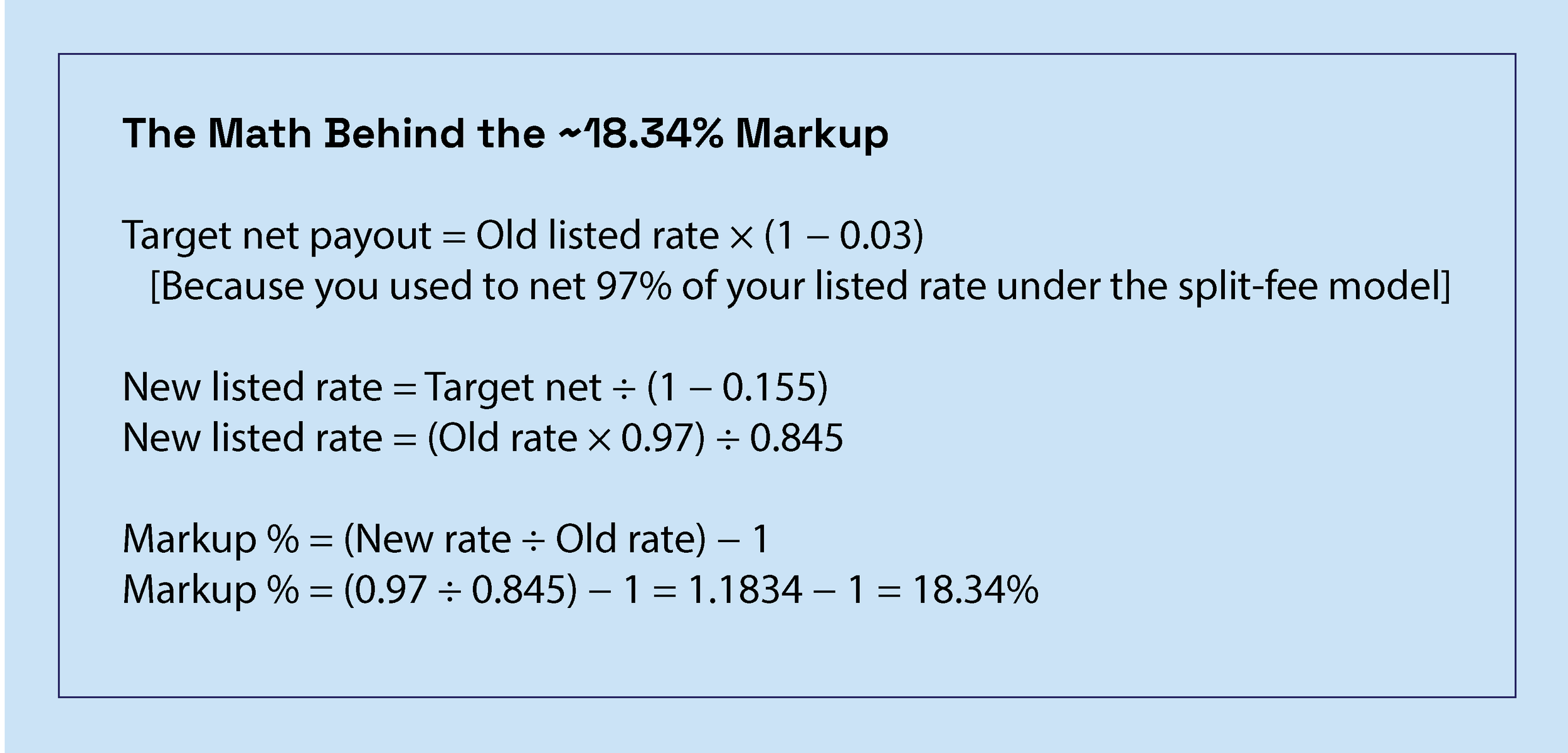
Account for Cleaning and Other Fees
One of the most overlooked areas of the new Fee Change is people only marking up their rates based on the nightly rent rate, not including their cleaning fee or other fees in their calculations. Airbnb's 15.5% fee applies to the entire booking subtotal, nightly rate plus cleaning fee plus any other host-charged fees like pet fees, extra guest fees, etc. So if you charge a $100 cleaning fee and your cleaner costs you $100, you're actually netting only $84.50 from that $100 after Airbnb takes its cut. You're subsidizing $15.50 of your cleaner's wages out of pocket.
To make the cleaning fee truly break even, you'd need to charge the same markup amount you are on the rent.
$100 ÷ 0.845 = $118.34
Same math as the nightly rate, the 18.34% markup applies equally to every fee line. It is important that when you are setting up your new rates that it includes the total for all the fees too.
Directly in Airbnb | Airbnb's native platform does not have a built-in markup tool for cleaning fees. You have to manually go into your listing and raise each fee individually. The recommendation from industry experts is to multiply every fixed fee — cleaning, pet, extra guest — by 1.1834 to preserve your net earnings after the 15.5% cut. So a $100 cleaning fee becomes $118.34, a $50 pet fee becomes $59.17, and so on. It's manual and a bit tedious, but it's the only option if you're managing directly through Airbnb.
Adjust in a PMS | This is where it gets interesting, and a little inconsistent depending on the platform. Some PMS platforms note that their markup feature applies to nightly rates only, and that other fees like cleaning fees are still subject to the 15.5% commission without automatic adjustment. That means even hosts using a PMS with an 18.34% markup applied may still be losing money on their cleaning fees if they haven't manually updated those fee amounts too. Guesty specifically recommends adding a cleaning fee at least 18.34% higher than your current fee, and increasing all additional fees by the same amount — noting that a 15.5% markup alone is not enough to cover the single fee.
The practical takeaway | There are two separate things they need to do — and most people only do one:
Apply the 18.34% markup or rate increase to their nightly rate
Manually raise every fee line — cleaning, pet, extra guest, any other host-charged fee — by 18.34% as well
Airbnb confirms this themselves: the service fee is calculated as a percentage of your nightly price plus any fees you've added, like a cleaning fee. Airbnb
Model Comparison
This is just meant to give an idea of different scenarios. Obviously, everyone would like the markup to cover the entire fees but it also means likely a higher overall rate for guests versus the old model, so it may not necessarily work all the time. But its a baseline goal and gives cushion. A markup of 15.5%, should essentially you keep the nightly rate pretty equal to what the guest was seeing on their end in the old model. If you did not increase your rates after the fee model change in October 2025, well then you are absorbing all the fees and losing money since the change.
Airbnb Fee Model Comparison
Based on a $200/night listed rate — showing host payout, Airbnb fees, and guest totals across all four scenarios
Old model (split fee)
Guest pays $228
Host nets $194
No adjustment
Guest pays $200
Host nets $169 ▼ $25/night
+15.5% rate increase
Guest pays $231
Host nets $195 ≈ even
+18.34% rate increase
Guest pays $237
Host nets $200 ▲ $6/night
Source: Legacy Tide Consulting — Short-Term Rental Consulting, Panama City Beach FL
Old Model (Split Fee) The original Airbnb structure. You listed at $200, netted $194 after the 3% host fee, and guests paid ~$228 with a separate service fee tacked on at checkout. That surprise add-on was a real friction point — guests saw $200 in search results and $228 by the time they went to book.
New Model — No Rate Adjustment What happens if you did nothing when Airbnb flipped the switch. Your listed rate stays at $200, guests actually pay less ($200 flat, no add-on fee), but Airbnb now pulls 15.5% from your side — dropping your payout to $169. A silent $25/night income cut with no visible change to your listing.
New Model — +15.5% Rate Increase The "close enough" fix. Raising your rate by 15.5% to $231 gets your payout back to roughly where it was ($195 vs. the old $194). Guests pay a bit more than before, but there's no separate fee line at checkout. A workable rule of thumb, though it slightly undershoots the full recovery target.
New Model — +18.34% Rate Increase The precise fix. Raising your rate by 18.34% to $236.68 means Airbnb's 15.5% cut comes entirely out of the price increase — your payout lands at $200, actually $6 more than the old model. Guests pay slightly more in total, but what they see listed is what they pay. No surprises, and your revenue is fully protected.
What This Means for VRBO and Direct Bookings
This change was Airbnb-specific. VRBO, direct bookings, and other platforms were not affected. If you manage your pricing across multiple channels, which most serious hosts should, you'll want to make sure your Airbnb-specific rates are adjusted independently of your VRBO or direct booking rates.
A good property management system (PMS) lets you set per-channel markups so you don't have to manage this manually. If you're not using a PMS and you list on multiple platforms, this is a good time to evaluate whether one makes sense for your business.
Action Steps for Hosts
If you haven't already, here's what to do:
Check your recent Airbnb payout statements and confirm you're seeing 15.5% deducted (not 3%). If you see 3%, contact Airbnb — you may not have been transitioned yet, but you will be.
Compare your current Airbnb listed rate to your old rate before October 27, 2025. Confirm the percentage you have raised it.
If you use a PMS, apply a channel-specific markup for Airbnb. Many platforms (Hostfully, Guesty, Lodgify, OwnerRez, etc.) have a dedicated field for this.
Review your cleaning fees and other host-charged fees as well — Airbnb's 15.5% applies to those too, not just the nightly rate, be sure you raised enough to cover the fees that applied to these items.
Consult a tax advisor. Because the gross amount Airbnb processes is now higher (the full guest-facing price flows through before the deduction), this may affect how you report income. Get guidance before you file.
Bottom Line
Airbnb's fee restructuring wasn't designed to hurt hosts — it was designed to reduce booking abandonment by eliminating the checkout sticker shock guests experienced when fees piled on at the end. The total money in the ecosystem is roughly the same.
But hosts who didn't adjust their rates are quietly leaving money on the table with every booking, especially if they are not accounting for their cleaning and other fees. The fix isn't complicated, remember its essentially the burden of accounting for the fees shifted to hosts, some hosts didn’t even realize the guest fee that was being charged to guests before since the hosts never saw or touched that money. Many were scared at the change, until they realize it was just a shift in the flow of the fees.
If you're unsure whether your rates are set correctly, or if you want help auditing your Airbnb listing's pricing strategy, we're here to help. A free listing audit from Legacy Tide Consulting takes a full look at your pricing, your listing presentation, and your competitive position in the market.