
Damage Waiver or Security Deposit?
Which One Actually Makes You Money?
Every vacation rental owner faces the same awkward question at setup: how do you protect a property worth hundreds of thousands of dollars from guests who are essentially strangers? The two most common answers are the security deposit and the damage waiver — and while they look similar on the surface, they behave very differently in practice. One is a safety net you give back. The other is income you keep.
This isn't an abstract debate. The choice you make will affect your booking conversion rate, your guest experience, your administrative workload, and — most importantly — your net revenue over hundreds of stays. Let's run the real numbers.
First, Let's Define the Terms The Security Deposit
A security deposit is a held amount — typically collected before or at check-in — that is fully refunded to the guest after their stay, provided no damage has occurred. The money sits in trust, uninvested and unavailable to you, until you either release it or file a claim. On most platforms, this process happens automatically within 3–14 days of checkout.
If damage does occur, you file a claim against the held funds. What you can actually collect depends on your platform's rules, the quality of your documentation, and the guest's willingness to accept the charge. Many claims are disputed, reduced, or denied outright.
The Damage Waiver A damage waiver is a small, non-refundable fee — often $25 to $89 per booking — that you collect upfront. In exchange, you agree to cover a defined amount of accidental damage (say, up to $500 or $1,500) out of that revenue pool. The guest doesn't get the money back. You don't have to ask for it back. It flows through as income, every single booking, without exception.
"The deposit feels safer because the number is bigger — $500 sounds more protective than $69. But protection and profit are two different things."
The 100-Booking Thought Experiment
Let's run two identical vacation rentals side by side over 100 bookings. Same property, same guests, same 3% damage rate — meaning 3 out of every 100 stays result in something that needs to be fixed. The cost to remedy those 3 incidents totals $1,500.
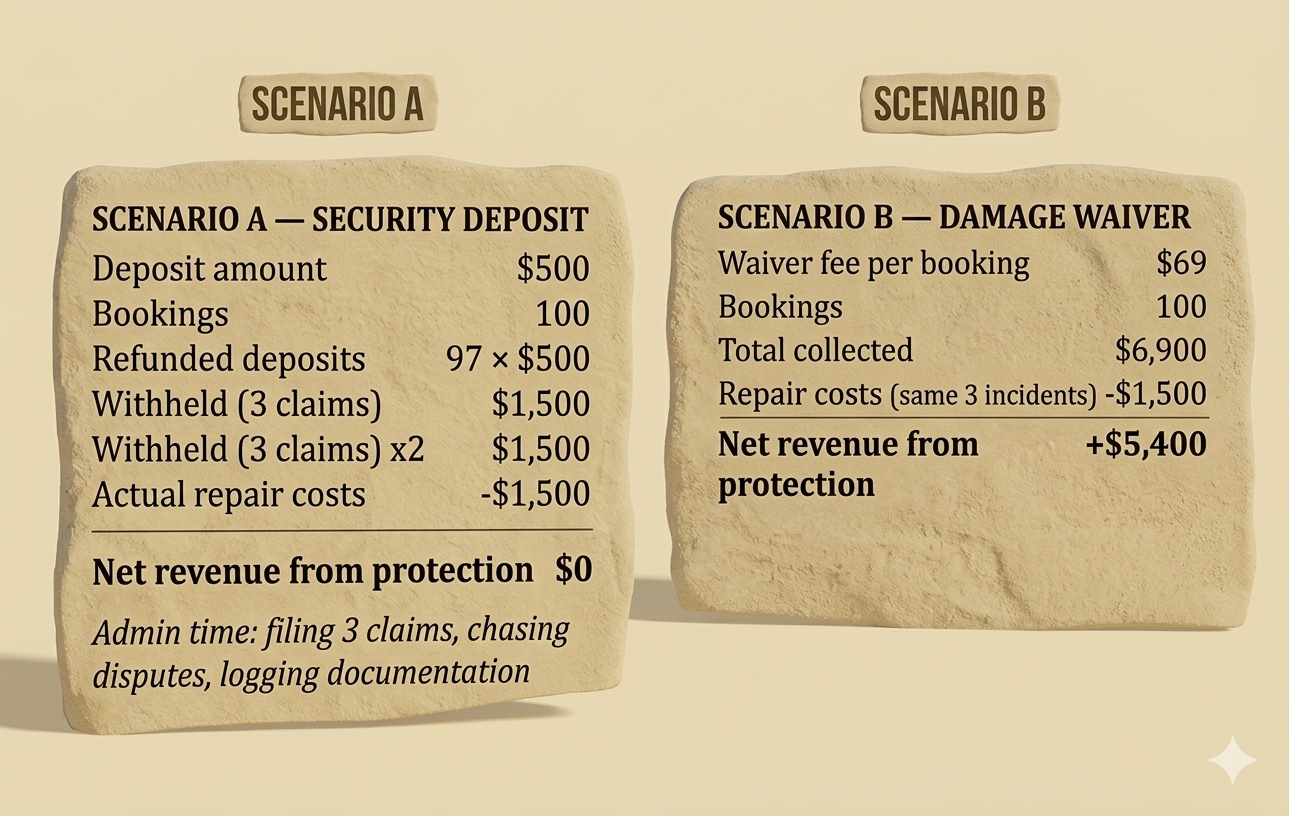
A sample breakdown of the potential impact of going with damage waivers.
The math is striking. Both scenarios absorbed the same $1,500 in real-world damage. But Scenario A produced exactly zero dollars of net protection revenue, while Scenario B put over $5,400 in your pocket. That's not a small difference — that's the equivalent of 3–5 additional nights of revenue on many properties, generated entirely from a fee most guests barely notice.
The Refundability Factor
This is the crux of everything. A security deposit is not income — it's a temporary float. You're holding money that is already mentally spent by your guest, and you're obligated to send it back. Your guests know this. Most of them aren't worried about the $500 deposit because they have no intention of damaging anything, and they expect a full refund as the baseline outcome.
A damage waiver, by contrast, is a fee. It functions exactly like a cleaning fee or a pet fee — it's a cost of booking, absorbed into the transaction, and it never re-enters the conversation. Guests don't spend the week hoping to get their $69 back. That distinction matters for cash flow, for accounting, and for the entire guest psychology of their stay.
Operational Note | Security deposits also carry hidden administrative costs that rarely get counted: time spent reviewing damage before release, documenting incidents with photos and receipts, managing platform-based claim disputes, and occasionally navigating chargebacks. On a 100-booking year, that friction compounds. The waiver eliminates nearly all of it.
The Rate Trade-Off: Nothing Is Free
Here's the part that honest advisors don't skip: adding a damage waiver will affect your overall rate presentation, and therefore your conversion. A $69 fee added to every booking is real money — it shows up in the total price guests see during checkout, and it will deter a small percentage of budget-sensitive bookers.
How much it costs you in occupancy depends on your market, your listing's competitive positioning, and how transparently the fee is presented. On most platforms, fees are displayed at checkout rather than in the initial search results, which softens the psychological impact. But it's still real friction. It can be positioned to guests as well, yes there may be a fee but now you do not have to wait 10 days to get your deposit released.
The calculation you need to run is this: at your typical nightly rate, how many additional declined bookings would it take to wipe out the $5,400 in net waiver revenue? For most properties with average bookings above $200/night, you'd need to lose multiple bookings per month before the math flips against you — an unlikely outcome if the fee is positioned correctly.
A security deposit, on the other hand, appears as a hold rather than a fee on most platforms — it doesn't inflate the listed price. But as we've seen, it also doesn't generate revenue. You're essentially offering "free protection" in exchange for administrative headaches and no upside.
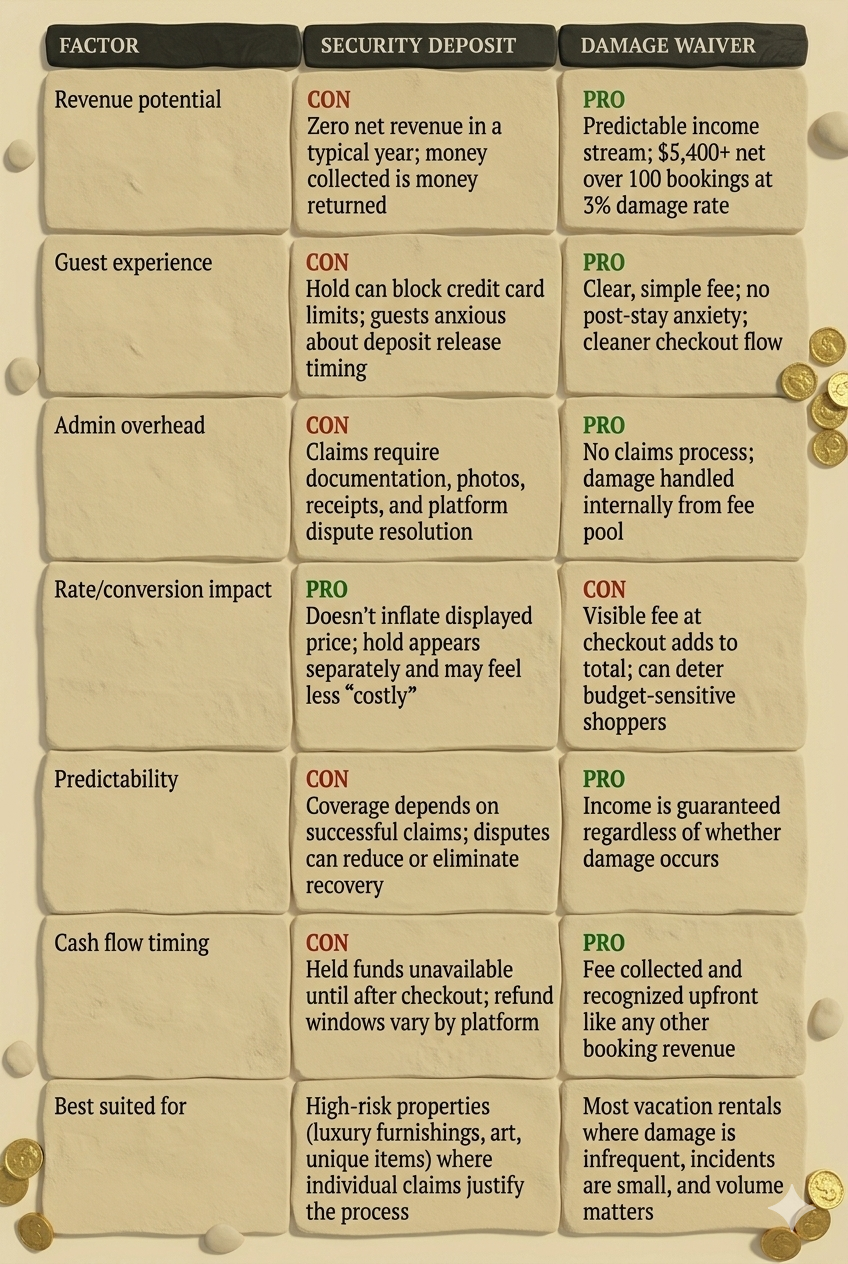
This chart just helps break down the differences.
When to Stick with a Deposit
There are legitimate scenarios where a security deposit is the right call. If your property contains items with significant replacement value — original artwork, custom furniture, irreplaceable antiques — then the higher ceiling of a traditional deposit makes sense. A $69 waiver doesn't cover a $3,000 custom dining table.
Similarly, if you're operating in a market where guests are accustomed to large deposits and see them as a quality signal, removing that entirely might create the wrong impression. High-end luxury rentals sometimes use deposits precisely because of how they position the property.
And if your platform simply doesn't support damage waivers in a structured way, a deposit may be your only practical option — though increasingly, platforms like Vrbo and direct booking sites make waivers straightforward to implement.
The Hybrid Approach Worth Considering
Some property managers split the difference. They charge a modest damage waiver to build a protection fund, and for bookings above a certain value (longer stays, large groups, peak holidays), they layer in a deposit on top. This gives you guaranteed baseline revenue while preserving the ability to recover against major incidents at high-risk bookings.
The key is intentionality. Know why you're charging what you're charging, know how much risk you're absorbing, and know the break-even point where your waiver revenue covers your historical damage costs. Once you have that number, the decision becomes clear.
Guaranteed Revenue Beats Theoretical Protection
Bottom Line…
At 100 bookings with a $500 deposit and a 3% damage rate, you collected $1,500 and spent $1,500. Net: zero. Your property was "protected," but you built nothing.
At 100 bookings with a $69 waiver, you collected $6,900 and spent $1,500. Net: over $5,400. Your property was equally protected — and you have real money to show for it.
The deposit feels more powerful because the dollar amount is bigger. But a held amount that you're obligated to return isn't income — it's a service you're providing for free. Some may still see security deposits as a better safety blanket and there is absolutely still a time and place for taking deposits. But the waiver turns your protection policy into a profit center. That's not a small distinction. Over five years and five hundred bookings, it's the difference between a cost center and a meaningful revenue line.
Run your own numbers. Identify risks and if it fits your model, it may not fit all. Set your waiver at a level where a reasonable year of incidents leaves you net positive. Price it as a fee guests can understand and accept. Then stop spending hours on claims and start spending that energy on the next booking.